AI tools are the new infrastructure of SaaS companies.
Running a SaaS company today means managing multiple moving parts at the same time. Customer acquisition, onboarding, product analytics, revenue forecasting, and support operations all require specialized software.
AI-powered tools are now helping SaaS teams automate these workflows. Instead of hiring large teams to manage sales outreach, customer support, marketing campaigns, and analytics dashboards, companies can rely on intelligent software that scales operations efficiently.
For SaaS startups and growing product companies, the right AI tools can significantly reduce operational costs while improving customer experience and revenue growth.
In this guide, we cover the best AI tools for SaaS companies across the entire growth stack, including lead generation, CRM platforms, sales automation, marketing automation, customer support systems, and product analytics tools.
If you are building or scaling a SaaS company, this guide will help you understand which tools are worth investing in and how they fit into your automation stack.
Why SaaS Companies Are Adopting AI Tools Rapidly
SaaS companies operate in extremely competitive markets. Growth teams are expected to generate qualified leads, close deals faster, and retain customers with excellent support.
Traditional workflows often require multiple manual processes. AI tools reduce this operational friction by automating repetitive tasks and generating insights faster.
Key benefits include:
Faster Lead Generation
AI prospecting tools can identify potential customers, enrich contact data, and prioritize leads automatically.
Better Sales Productivity
Sales teams spend less time researching prospects and more time closing deals.
Scalable Customer Support
AI chatbots and automated ticketing systems handle common customer queries instantly.
Smarter Marketing Campaigns
AI-driven marketing automation platforms personalize messaging and optimize campaign performance.
Product Analytics and Customer Insights
AI analytics platforms help product teams understand user behavior and predict churn risk.
These advantages make AI tools an essential part of modern SaaS infrastructure.
SaaS companies that rely on outbound sales often use AI powered prospecting platforms to identify potential buyers and enrich contact data automatically. These tools help sales teams build targeted prospect lists and prioritize high intent leads. If you want to explore the most effective platforms available today, see our detailed guide on AI Tools for B2B Lead Generation.
AI Tools Pricing Comparison for SaaS Companies
| Category | Tool | Starting Price | Best For | Free Trial |
|---|---|---|---|---|
| Lead Generation | Apollo | $49/month | SaaS startups | Yes |
| Lead Generation | ZoomInfo | Custom pricing | Enterprise prospecting | Demo |
| CRM | HubSpot CRM | $20/user/month | Growth stage SaaS | Yes |
| CRM | Zoho CRM | $14/user/month | Small businesses | Yes |
| Sales Automation | Reply.io | $60/month | Outbound sales teams | Yes |
| Sales Automation | Outreach | Custom pricing | Enterprise sales | Demo |
| Email Marketing | Brevo | $25/month | Transactional emails | Yes |
| Email Marketing | ActiveCampaign | $29/month | Marketing automation | Yes |
| Customer Support | Freshdesk | $15/agent/month | Startup support teams | Yes |
| Customer Support | Zendesk | $49/agent/month | Enterprise support | Demo |
| Product Analytics | Mixpanel | Free plan | Product analytics | Yes |
| Product Analytics | Amplitude | Free plan | Product-led growth teams | Yes |
AI Lead Generation Tools for SaaS Companies
Generating qualified leads is the foundation of any SaaS growth strategy. AI-powered lead generation tools help companies identify potential customers and enrich contact data automatically.
These platforms combine data intelligence, automation, and predictive algorithms to improve prospect targeting.
Popular AI Lead Generation Tools
Some of the most widely used lead generation platforms include:
Apollo
ZoomInfo
Cognism
Lusha
Clay
These tools provide large B2B contact databases combined with automation workflows.
Key Features
AI lead generation platforms typically include:
• prospect database access
• email and phone number enrichment
• buyer intent signals
• automated prospecting workflows
• CRM integrations
For SaaS startups targeting specific industries or job roles, these tools dramatically improve outbound efficiency.
Pricing Comparison
| Tool | Starting Price | Best For |
|---|---|---|
| Apollo | $49 per month | startups and small sales teams |
| ZoomInfo | custom pricing | enterprise sales organizations |
| Cognism | custom pricing | GDPR compliant prospecting |
| Lusha | $39 per month | small B2B teams |
| Clay | usage based | advanced data automation |
ROI for SaaS Companies
A typical SaaS sales representative may spend several hours per day researching prospects. AI lead generation platforms automate this process and allow teams to contact more qualified leads.
Even a small improvement in conversion rate can significantly increase revenue for SaaS companies.
👉 For a detailed comparison, see our guide on AI Tools for B2B Lead Generation.
AI CRM Tools for SaaS Sales Teams
Customer relationship management platforms act as the central system for managing prospects, deals, and customer interactions.
Modern AI-powered CRM platforms provide predictive insights that help sales teams close deals more efficiently.
Leading AI CRM Platforms
Popular CRM solutions used by SaaS companies include:
HubSpot CRM
Salesforce
Zoho CRM
Pipedrive
Freshsales
These platforms integrate with marketing tools, analytics systems, and customer support software.
Key Features
AI-powered CRM systems offer:
• automated lead scoring
• sales pipeline forecasting
• email and call tracking
• workflow automation
• revenue analytics
These capabilities help SaaS companies track the entire customer journey from lead generation to closed deals.
Pricing Comparison
| CRM Platform | Starting Price | Best For |
|---|---|---|
| HubSpot | $20 per user per month | startups and growth teams |
| Zoho CRM | $14 per user per month | small businesses |
| Pipedrive | $14 per user per month | mid-sized teams |
| Freshsales | $18 per user per month | mid sized teams |
| Salesforce | enterprise pricing | large SaaS companies |
CRM systems often become the operational backbone of SaaS companies as they scale.
👉 Read our full breakdown: AI CRM Tools Pricing Comparison for SaaS Teams.
CRM platforms act as the operational backbone of most SaaS companies. They store customer data, track deal pipelines, and integrate with marketing and support tools. If you want to compare the leading CRM platforms used by SaaS teams, read our complete AI CRM Tools Pricing Comparison for SaaS Teams.
AI Sales Automation Tools
Sales teams spend a significant amount of time performing repetitive tasks such as sending outreach emails, scheduling follow-ups, and updating CRM records.
AI sales automation tools streamline these processes and improve pipeline efficiency.
Popular Sales Automation Platforms
Examples include:
Outreach
Salesloft
Reply.io
Apollo
HubSpot Sales Hub
These platforms integrate with CRM systems and automate outbound communication.
Core Capabilities
Sales automation tools typically provide:
• automated email sequences
• LinkedIn outreach automation
• meeting scheduling
• pipeline tracking
• AI generated follow up suggestions
By automating repetitive outreach workflows, sales teams can focus more on closing deals.
Pricing Comparison
| Tool | Starting Price | Ideal Team Size |
|---|---|---|
| Reply.io | $60 per month | small sales teams |
| Apollo | $49 per month | startups |
| Salesloft | enterprise pricing | mid market teams |
| Outreach | enterprise pricing | large sales organizations |
For SaaS companies with outbound sales teams, automation platforms often produce significant ROI.
AI Email Marketing Tools
Email marketing continues to be one of the highest ROI marketing channels for SaaS companies.
AI-powered email marketing platforms help automate campaigns, personalize messaging, and optimize deliverability.
Leading Email Marketing Platforms
Common platforms include:
ActiveCampaign
Brevo
Mailchimp
HubSpot Marketing Hub
Klaviyo
These platforms allow SaaS companies to manage onboarding emails, nurture campaigns, and product announcements.
Key Features
AI email marketing tools typically include:
• automated email sequences
• behavioral segmentation
• AI generated subject lines
• deliverability optimization
• campaign analytics
Personalized email campaigns can significantly improve customer engagement and retention.
Pricing Comparison
| Platform | Starting Price | Best Use Case |
|---|---|---|
| Brevo | $25 per month | transactional emails |
| Mailchimp | $13 per month | small marketing teams |
| ActiveCampaign | $29 per month | marketing automation |
| HubSpot | $20 per month | integrated CRM marketing |
| Klaviyo | usage based | ecommerce marketing |
👉 Explore our detailed comparison: AI Tools for Email Marketing.
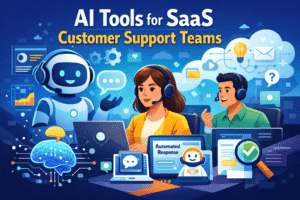
AI Customer Support Tools for SaaS Companies
Customer support is a critical function for SaaS businesses. As user bases grow, handling support requests manually becomes difficult.
AI customer support platforms help automate ticketing, chat support, and knowledge base management.
Popular Support Platforms
Widely used support tools include:
Zendesk
Intercom
Freshdesk
Help Scout
Tidio
These platforms combine AI chatbots with ticket management systems.
Key Capabilities
AI support platforms typically provide:
• automated chatbots
• ticket routing automation
• customer knowledge bases
• conversation analytics
• CRM integrations
These features allow SaaS companies to handle thousands of support queries efficiently.
Pricing Comparison
| Platform | Starting Price | Ideal For |
|---|---|---|
| Freshdesk | $15 per agent | startups |
| Help Scout | $20 per user | customer focused teams |
| Intercom | $39 per month | SaaS product companies |
| Zendesk | $49 per agent | enterprise support teams |
Automating support workflows improves response times and customer satisfaction.
👉 See our full guide: AI Tools for SaaS Customer Support Teams.
AI Product Analytics Tools
Product analytics tools help SaaS companies understand how users interact with their product.
These insights help teams improve onboarding flows, optimize features, and reduce churn.
Popular Analytics Platforms
Common product analytics tools include:
Mixpanel
Amplitude
Heap
Pendo
PostHog
These tools track user behavior and generate insights about product usage.
Key Features
AI analytics platforms often provide:
• user journey tracking
• funnel analysis
• cohort analysis
• feature adoption metrics
• churn prediction models
For SaaS companies focused on product-led growth, analytics platforms are essential.
Pricing Comparison
| Tool | Starting Price | Best For |
|---|---|---|
| Mixpanel | free plan available | startups |
| Amplitude | free plan available | developer-focused teams |
| Heap | custom pricing | advanced analytics |
| Pendo | enterprise pricing | product experience management |
| PostHog | usage based | developer focused teams |
Analytics platforms provide actionable insights that help SaaS companies optimize product engagement.
Product analytics platforms help SaaS companies understand how users interact with their applications. By analyzing product usage data, teams can improve onboarding flows, identify feature adoption trends, and reduce customer churn. If you want a deeper comparison of the leading analytics platforms used by SaaS companies, read our detailed guide on AI Analytics Tools for SaaS Companies.
Example AI Automation Stack for SaaS Companies
Modern SaaS companies rely on a combination of AI-powered tools that work together to automate marketing, sales, customer success, and product analytics.
Instead of operating in isolated systems, these tools integrate to create a unified SaaS growth engine.
Below is an example architecture used by many SaaS startups and scale-ups.
SaaS Growth Stack
Customer Acquisition Layer
AI lead generation tools identify potential prospects and enrich contact data automatically.
Examples include:
Apollo
ZoomInfo
Cognism
These platforms feed qualified leads into the CRM system.
Sales Operations Layer
Sales automation tools manage outbound campaigns, follow-ups, and meeting scheduling.
Typical tools include:
Reply.io
Outreach
Salesloft
These tools integrate directly with CRM platforms to maintain accurate pipeline data.
Customer Relationship Management
The CRM system acts as the central hub for managing deals and customer interactions.
Popular SaaS CRM platforms include:
HubSpot
Salesforce
Zoho CRM
The CRM tracks the entire lifecycle of a customer from lead generation to renewal.
Customer Engagement Layer
Email marketing platforms manage onboarding emails, product announcements, and lifecycle campaigns.
Common tools include:
ActiveCampaign
Brevo
HubSpot Marketing Hub
These tools help SaaS companies nurture leads and retain customers.
Customer Support Infrastructure
AI-powered support platforms automate customer queries and ticket management.
Examples include:
Zendesk
Freshdesk
Intercom
These tools reduce response time and improve customer satisfaction.
Product Analytics Layer
Product analytics tools provide insights into user behavior and feature adoption.
Examples include:
Mixpanel
Amplitude
Heap
These insights help SaaS companies improve onboarding and reduce churn.
How SaaS Companies Should Build Their AI Automation Stack
Instead of using isolated tools, SaaS companies should build an integrated technology stack.
A typical SaaS automation stack may include:
Growth and Marketing
Lead generation platform
CRM system
email marketing automation
Sales Operations
sales automation software
meeting intelligence tools
pipeline analytics
Customer Experience
customer support platform
knowledge base tools
customer success analytics
Product Insights
product analytics platform
user behavior tracking tools
feature adoption monitoring
Integrating these systems allows SaaS companies to maintain a unified view of the customer journey.
How AI Tools Improve ROI for SaaS Companies
One of the main reasons SaaS companies invest in AI tools is the potential return on investment.
Automation platforms often reduce operational costs while increasing revenue opportunities.
Below is a simplified example.
Example ROI Calculation
Assume a SaaS company has:
• 3 sales representatives
• average deal size of $2,000
• monthly target of 10 deals per rep
Without automation tools, sales representatives may spend a significant amount of time researching prospects and manually sending follow-up emails.
AI sales automation platforms can reduce these manual tasks significantly.
If automation helps each sales representative close one additional deal per month, the revenue impact becomes substantial.
Example Scenario
| Metric | Without AI Tools | With AI Tools |
|---|---|---|
| Deals Closed per Rep | 10 | 11 |
| Total Deals (3 reps) | 30 | 33 |
| Revenue per Deal | $2,000 | $2,000 |
| Monthly Revenue | $60,000 | $66,000 |
In this example, AI tools generate an additional $6,000 in monthly revenue.
Even if the automation software costs $300 to $500 per month, the return on investment remains significant.
Choosing the Right AI Tools for Your SaaS Company
Selecting the right tools depends on the size and stage of your company.
Early Stage SaaS Startups
Startups should prioritize cost-effective tools with automation capabilities.
Recommended stack:
Apollo for lead generation
HubSpot CRM
Brevo for email marketing
Freshdesk for support
Growth Stage SaaS Companies
Companies scaling rapidly need deeper integrations and analytics.
Recommended stack:
ZoomInfo or Cognism
HubSpot or Salesforce
ActiveCampaign
Intercom
Enterprise SaaS Organizations
Large SaaS companies require highly scalable platforms.
Recommended stack:
Salesforce
Marketo
Zendesk
Amplitude
Choosing tools that integrate well together is critical for long term scalability.
Future Trends in AI for SaaS Companies
AI capabilities are evolving quickly and will continue to reshape how SaaS companies operate.
Several trends are expected to become more important in the coming years.
Predictive Revenue Analytics
AI platforms will provide deeper insights into revenue forecasting and pipeline health.
Autonomous Customer Support
Advanced chatbots will resolve most support queries without human intervention.
AI-Driven Personalization
Marketing campaigns and product experiences will become more personalized using behavioral data.
Intelligent Workflow Automation
AI assistants will automate complex business workflows across multiple platforms.
SaaS companies that adopt these technologies early will gain a competitive advantage.
Final Thoughts
AI tools are transforming how SaaS companies manage growth, sales operations, marketing campaigns, and customer support.
Instead of relying on manual processes, companies can now automate large parts of their operations with intelligent software.
The most effective SaaS technology stack typically includes:
• lead generation tools
• CRM systems
• sales automation platforms
• email marketing software
• customer support solutions
• product analytics tools
Selecting the right combination of tools helps SaaS companies scale efficiently while improving customer experience and operational efficiency.
As AI capabilities continue to evolve, SaaS companies that build strong automation stacks will be better positioned to compete in increasingly crowded markets.
Explore More AI Tools for SaaS Growth
Building a scalable SaaS company requires the right combination of AI powered tools across marketing, sales, and customer operations. If you want to explore specific tools in more depth, the following guides provide detailed comparisons and pricing breakdowns.
• AI Tools for B2B Lead Generation
• AI CRM Tools Pricing Comparison
• AI Tools for Email Marketing
• AI Tools for SaaS Customer Support Teams
• AI Analytics Tools for SaaS Companies
FAQs: AI Tools for SaaS Companies
What are the most important AI tools for SaaS companies?
The most important AI tools for SaaS companies typically include solutions for lead generation, CRM management, sales automation, email marketing, customer support, and product analytics.
Many SaaS startups use a combination of tools such as CRM platforms, marketing automation software, and AI-powered customer support systems to streamline operations and improve growth.
For example, AI lead generation tools help identify potential customers, while CRM platforms track sales pipelines and customer interactions. AI customer support platforms automate ticket handling and chat conversations, allowing SaaS companies to support a growing user base efficiently.
How do AI tools help SaaS companies scale faster?
AI tools help SaaS companies scale faster by automating repetitive tasks across marketing, sales, and customer support operations.
Instead of manually managing outreach campaigns or responding to customer queries, AI software can perform these tasks automatically.
For example, AI sales automation tools can send personalized follow up emails, while AI support platforms can handle common customer queries using chatbots.
This automation reduces operational workload and allows teams to focus on strategic tasks such as product development and revenue growth.
What is the best CRM software for SaaS startups?
The best CRM software for SaaS startups depends on the size of the company and the complexity of its sales process.
Many early-stage SaaS startups use lightweight CRM platforms that provide automation features without high enterprise costs.
Popular CRM platforms for SaaS companies include HubSpot CRM, Zoho CRM, Pipedrive, and Freshsales.
These systems help track leads, manage sales pipelines, and integrate with marketing automation and support tools.
Which AI marketing tools are best for SaaS growth?
AI marketing automation platforms help SaaS companies generate leads, nurture prospects, and convert trial users into paying customers.
Popular marketing automation tools include platforms that provide campaign automation, audience segmentation, and email personalization features.
These tools allow SaaS companies to run targeted campaigns that improve customer acquisition and retention.
Many SaaS companies integrate marketing automation platforms with their CRM system to create a unified view of customer data.
What are AI sales automation tools for SaaS companies?
AI sales automation tools help SaaS sales teams manage outbound outreach, follow-ups, and lead tracking more efficiently.
These platforms automate repetitive tasks such as sending follow-up emails, scheduling meetings, and updating CRM records.
Common features include automated email sequences, lead scoring algorithms, and pipeline analytics dashboards.
By reducing manual tasks, sales automation tools allow SaaS sales representatives to focus more on closing deals and building customer relationships.
Are AI customer support tools necessary for SaaS companies?
AI customer support tools are becoming essential for SaaS companies because user bases often grow quickly.
As more customers join a SaaS platform, support teams must handle increasing numbers of queries.
AI support tools provide chatbots, automated ticket routing, and knowledge base systems that allow companies to manage large volumes of customer requests efficiently.
These tools improve response time and help maintain a high-quality customer experience.
How much do AI tools for SaaS companies cost?
The cost of AI tools for SaaS companies varies depending on the type of platform and the size of the team using it.
Some tools offer free plans or entry-level pricing starting around $20 to $50 per month, while enterprise software platforms may cost hundreds or thousands of dollars per month.
Many SaaS companies start with affordable tools during early growth stages and later upgrade to more advanced platforms as their operations scale.
What is an AI-powered SaaS automation stack?
An AI-powered SaaS automation stack refers to the collection of software tools that automate different aspects of a SaaS business.
This typically includes tools for:
lead generation
customer relationship management
sales automation
email marketing
customer support
product analytics
When these systems integrate together, they create a unified infrastructure that allows SaaS companies to manage growth more efficiently.