Let AI Answer the Questions—
You Deliver the Experience
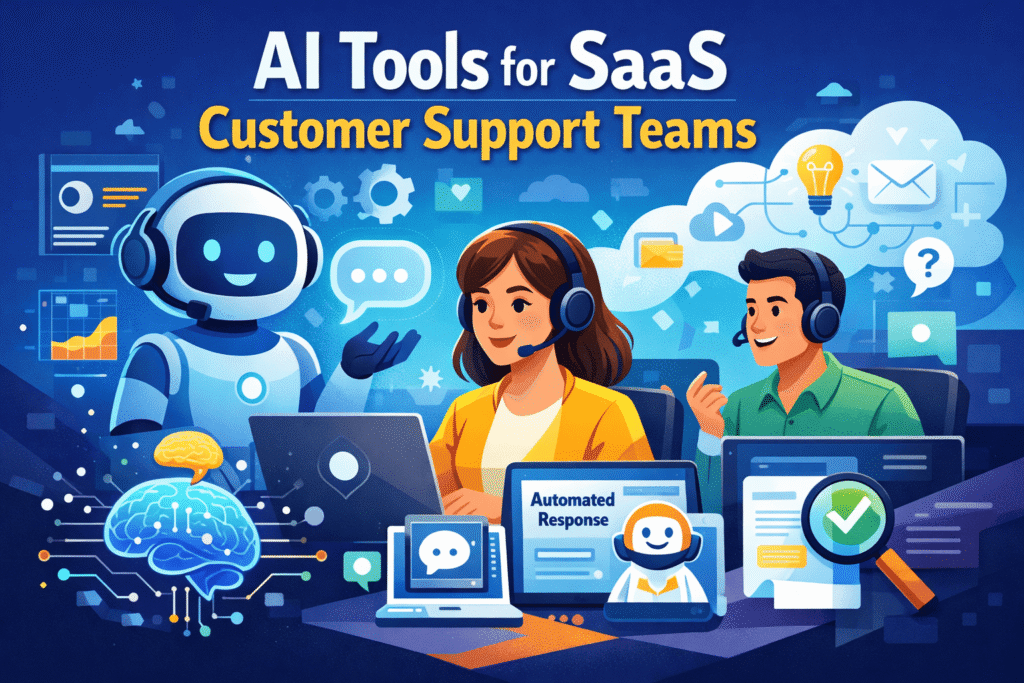
Customer support is one of the most critical functions for SaaS companies. Slow responses, unresolved tickets, or poor onboarding experiences often lead directly to customer churn.
Modern SaaS companies increasingly rely on AI-powered customer support tools to automate repetitive tasks, reduce support costs, and deliver faster responses to customers.
These platforms combine AI chatbots, ticket automation, knowledge bases, and analytics to improve support operations while allowing human agents to focus on complex issues.
In this guide, we compare the best AI tools for SaaS customer support teams, including their pricing models, automation capabilities, and best use cases.
Whether you’re a startup SaaS company or an enterprise software provider, the right support platform can significantly improve customer satisfaction, retention, and operational efficiency.
Quick Comparison: AI Customer Support Tools for SaaS
| Tool | Starting Price | Best For | Key Features |
|---|---|---|---|
| Zendesk AI | $49/agent/month | Mid-size SaaS teams | AI ticket routing, automation |
| Intercom | $74+/month | SaaS startups | AI chatbot + messaging |
| Freshdesk Freddy AI | $29/agent/month | Growing support teams | AI ticket categorization |
| Help Scout | $20/user/month | Small SaaS companies | Simple shared inbox |
| Drift | Custom pricing | Sales + support automation | Conversational AI |
| Tidio | $29/month | Small SaaS teams | AI chatbot automation |
| Ada | Custom pricing | Enterprise SaaS | AI self-service automation |
| Zoho Desk | $20/agent/month | Budget support teams | AI assistant Zia |
| LivePerson | Custom pricing | Large enterprises | Conversational AI |
| HubSpot Service Hub | $45+/month | CRM-centric SaaS | Support + CRM integration |
Why SaaS Companies Use AI Customer Support Tools
AI-powered customer support platforms help SaaS companies manage large volumes of support requests while maintaining high response quality.
Faster Response Times
AI chatbots can respond instantly to common questions such as:
• password reset requests
• billing issues
• onboarding questions
• feature explanations
This dramatically reduces first-response time, a key support metric.
Automated Ticket Routing
AI systems analyze incoming tickets and automatically route them to the correct team or agent.
For example:
• billing issues → finance support
• technical errors → engineering support
• onboarding questions → customer success
This reduces delays and improves resolution times.
Reduced Support Costs
Support automation allows SaaS companies to resolve many requests without human intervention.
Common automated workflows include:
• account status checks
• subscription changes
• product documentation answers
• onboarding assistance
Many SaaS companies report 30–50% reduction in support workload after implementing AI automation.
How to Choose the Right AI Customer Support Platform
Selecting the right tool depends on your company’s size, support complexity, and budget.
Here are the most important factors to consider.
Ticket Volume
Companies handling thousands of tickets monthly require advanced automation and analytics.
Platforms such as Zendesk or Intercom are better suited for high ticket volumes.
Smaller SaaS teams may prefer simpler platforms like Help Scout or Tidio.
Automation Capabilities
Look for platforms that support:
• AI chatbots
• automated workflows
• ticket categorization
• knowledge base suggestions
Automation is the key driver of support efficiency. Lead generation and marketing automation tools also integrate with customer support platforms. Explore our guide to AI Tools for B2B Lead Generation to understand how SaaS companies capture and qualify leads.
Integration With CRM
Support software must integrate with your CRM platform.
CRM integration allows agents to access:
• customer history
• subscription details
• product usage data
If you’re evaluating CRM platforms as well, compare pricing options in our AI CRM Tools Pricing Comparison Guide.
Analytics and Reporting
Advanced analytics help SaaS companies monitor important support metrics such as:
• first response time
• resolution time
• ticket backlog
• customer satisfaction scores
These insights help improve support processes over time.
ROI of AI Customer Support Tools for SaaS Companies
Many SaaS companies evaluate support software purely based on subscription cost. However, the real value of AI-powered customer support tools lies in operational efficiency and improved customer retention.
Below are the primary ways these platforms generate measurable return on investment.
Reduced Support Team Workload
AI automation can significantly reduce the number of support tickets handled by human agents.
For example:
If a SaaS company receives 2,000 support tickets per month, and AI resolves 40 percent automatically, that reduces manual tickets to 1,200.
If the average handling time per ticket is 8 minutes, automation saves approximately 106 hours of support time every month.
This allows companies to scale without continuously hiring additional support staff.
Faster Response Times
Customers increasingly expect instant responses when they contact support.
AI tools allow companies to respond immediately through:
• chatbots
• automated email responses
• self-service knowledge base recommendations
Faster responses improve customer experience and increase satisfaction scores.
Improved Customer Retention
Customer support quality directly impacts SaaS churn rates.
When customers receive fast and helpful support responses, they are more likely to continue using the product.
AI-powered systems also help support teams identify at-risk users by analyzing behavioral patterns, enabling proactive intervention.
Reducing churn by even 2–3 percent can significantly increase lifetime customer value.
Better Support Analytics
Modern support platforms provide advanced analytics dashboards.
Companies can track metrics such as:
• average response time
• resolution time
• customer satisfaction scores
• ticket volume trends
These insights allow SaaS companies to continuously improve their support operations.
Scalable Customer Support Operations
As SaaS companies grow, customer support demand increases.
Without automation, scaling support requires hiring more agents.
AI automation enables companies to support thousands of users without proportional increases in staffing costs.
This scalability makes AI-powered customer support tools a critical component of modern SaaS operations.
Best AI Tools for SaaS Customer Support
Below is a detailed breakdown of the leading platforms used by SaaS companies.
1. Zendesk AI
Zendesk is one of the most widely used customer support platforms in the SaaS industry.
Key Features
• AI-powered ticket routing
• automated responses
• multi-channel support
• advanced analytics
Zendesk also integrates with many SaaS tools including Slack, Salesforce, and Shopify.
Pricing
Zendesk plans start around $49 per agent per month, depending on features.
Best For
Mid-sized SaaS companies that require scalable support operations.
2. Intercom
Intercom combines messaging, chatbots, and automation into one platform.
Key Features
• AI chatbot for instant responses
• product onboarding messages
• customer segmentation
• automated workflows
Many SaaS startups use Intercom to handle both support and onboarding communication.
Pricing
Intercom plans start around $74 per month, with higher tiers for automation features.
Best For
SaaS startups focused on improving onboarding and customer engagement.
3. Freshdesk Freddy AI
Freshdesk includes an AI assistant called Freddy AI that helps automate ticket management.
Key Features
• ticket classification
• AI knowledge suggestions
• automated workflows
• customer self-service portals
Pricing
Freshdesk plans start around $29 per agent per month.
Best For
Growing SaaS companies that want automation without enterprise pricing.
4. Help Scout
Help Scout focuses on simplicity and usability.
Key Features
• shared inbox
• knowledge base tools
• customer profiles
• reporting dashboards
Unlike some complex enterprise tools, Help Scout prioritizes ease of use.
Pricing
Plans start at $20 per user per month.
Best For
Small SaaS companies with smaller support teams.
5. Drift
Drift provides conversational AI that combines support and sales communication.
Key Features
• AI chatbots
• lead qualification
• live chat automation
• conversation analytics
Pricing
Pricing is typically custom for enterprise customers.
Best For
SaaS companies that want to combine customer support and lead generation.
6. Tidio
Tidio offers AI chatbot automation for small teams.
Key Features
• chatbot automation
• live chat
• ticketing system
• email integration
Pricing
Plans start around $29 per month.
Best For
Small SaaS teams with limited budgets.
7. Ada
Ada is a powerful AI automation platform designed for enterprise companies.
Key Features
• AI self-service support
• automated workflows
• multilingual chatbot support
Pricing
Pricing is custom based on usage.
Best For
Large SaaS companies handling high volumes of support interactions.
8. Zoho Desk
Zoho Desk includes an AI assistant called Zia.
Key Features
• ticket automation
• AI-powered insights
• knowledge base tools
Pricing
Plans start around $20 per agent per month.
Best For
Budget-conscious SaaS companies.
9. LivePerson
LivePerson focuses on conversational AI.
Key Features
• AI messaging
• chatbot automation
• advanced analytics
Pricing
Custom enterprise pricing.
Best For
Large companies handling millions of customer interactions.
10. HubSpot Service Hub
HubSpot provides customer support tools integrated directly with its CRM.
Key Features
• ticket automation
• knowledge base tools
• customer feedback surveys
Pricing
Plans start around $45 per month.
Best For
Companies already using HubSpot CRM.
How AI Automates Customer Support Workflows in SaaS Companies
One of the biggest advantages of AI-powered customer support tools is workflow automation. Instead of manually responding to every ticket, SaaS companies can automate repetitive support tasks while allowing human agents to focus on complex issues.
Below are some of the most common AI-driven support workflows used by modern SaaS companies.
Automated Ticket Categorization
AI systems can automatically categorize incoming support requests based on the issue type.
For example, tickets can be classified into:
• billing questions
• login issues
• onboarding help
• feature requests
• technical bugs
Instead of manually reviewing every ticket, AI instantly assigns the ticket to the appropriate support queue. This reduces response time and ensures that specialized agents handle the right issues.
AI Chatbots for First-Level Support
AI chatbots are now capable of resolving a large percentage of customer questions without human intervention.
Common chatbot use cases include:
• password reset instructions
• product documentation guidance
• subscription plan questions
• account setup instructions
For SaaS companies with high user volume, chatbots can resolve up to 40–60 percent of support queries automatically, dramatically reducing workload for support teams.
Smart Ticket Routing
AI can also route support tickets to the most appropriate support agent.
Routing can be based on:
• product expertise
• customer account tier
• ticket urgency
• previous interaction history
This ensures that high-value customers receive priority service while reducing ticket handling time.
Self-Service Knowledge Bases
AI tools can also recommend relevant knowledge base articles based on a customer’s question.
For example, if a user asks about API integration, the AI system can instantly suggest documentation articles or tutorials.
This encourages self-service support, which many SaaS customers prefer.
Proactive Customer Support
Advanced AI platforms can even detect potential problems before customers report them.
For example:
• monitoring product usage patterns
• detecting feature failures
• identifying onboarding issues
AI systems can automatically send guidance messages to users before frustration escalates into support tickets.
This proactive approach improves customer satisfaction and reduces churn.
Pricing Models for SaaS Customer Support Tools
Customer support platforms typically use three pricing structures.
Per Agent Pricing
Most platforms charge based on the number of support agents.
Typical range:
$20 – $150 per agent per month.
Usage-Based Pricing
Some AI chatbot platforms charge based on:
• conversations
• automation volume
• ticket count
Enterprise Licensing
Large SaaS companies often negotiate custom contracts that include:
• dedicated support
• API access
• advanced analytics
ROI Example: AI Customer Support Automation
Let’s look at a practical example.
Assume a SaaS company receives:
• 1,200 support tickets per month
• average handling time: 8 minutes
• support cost: $35/hour
Monthly support workload:
1,200 × 8 minutes = 160 hours
160 hours × $35 = $5,600 monthly support cost
If AI automation resolves 40% of tickets automatically, the new workload becomes:
720 tickets = 96 hours
96 × $35 = $3,360 monthly cost
Monthly savings:
$2,240
Annual savings:
$26,880
Automation quickly pays for itself.
The Future of AI Customer Support in SaaS
AI support tools continue evolving rapidly.
Future trends include:
• predictive support automation
• AI voice support agents
• real-time product usage insights
• automated onboarding assistants
SaaS companies that adopt automation early often gain competitive advantages in customer satisfaction and retention.
Implementation Roadmap for AI Customer Support in SaaS Companies
Adopting AI-powered customer support tools requires a strategic approach. Implementing too many tools at once can overwhelm support teams and create unnecessary complexity.
Below is a practical roadmap SaaS companies can follow when introducing AI automation.
Step 1: Identify High-Volume Support Issues
The first step is identifying the most common support questions.
Typical examples include:
• account login problems
• billing questions
• onboarding assistance
• feature explanations
These repetitive queries are ideal candidates for automation.
Step 2: Implement AI Chatbots
Once common support issues are identified, companies can deploy AI chatbots to handle basic customer questions.
Chatbots can:
• answer frequently asked questions
• guide users through product features
• direct customers to relevant documentation
This immediately reduces the number of manual tickets handled by support agents.
Step 3: Build a Self-Service Knowledge Base
A well-organized knowledge base helps customers solve problems independently.
AI-powered support tools can recommend knowledge base articles based on user questions.
Self-service support reduces ticket volume while improving customer satisfaction.
Step 4: Introduce Advanced Automation
Once the basics are implemented, companies can expand automation to include:
• automated ticket routing
• workflow automation
• predictive customer support
These features improve efficiency across the entire support operation.
Step 5: Monitor Performance Metrics
After implementation, support teams should monitor key performance indicators such as:
• ticket resolution time
• customer satisfaction score (CSAT)
• chatbot resolution rate
• ticket backlog
Continuous monitoring allows companies to refine automation strategies and maximize efficiency.
FAQs for AI Tools for B2B Lead Generation
What is the best AI tool for SaaS customer support?
Popular options include Zendesk, Intercom, and Freshdesk because they combine automation, ticket management, and analytics.
How much does customer support software cost?
Pricing typically ranges between $20 and $150 per agent per month, depending on features and company size.
Can AI replace human support agents?
AI tools automate repetitive tasks, but human agents are still necessary for complex technical issues.
Do AI support tools integrate with CRM systems?
Yes. Most platforms integrate with major CRM systems like Salesforce, HubSpot, and Zoho.
Customer support also connects closely with customer onboarding and email automation workflows. See our comparison of AI Email Marketing Tools for SaaS Companies.
Final Thoughts
AI customer support tools help SaaS companies deliver faster responses, reduce operational costs, and improve customer satisfaction.
By automating routine support tasks, these platforms allow teams to focus on solving complex problems and building stronger relationships with customers.
Whether you’re a startup SaaS company or an enterprise organization, implementing the right AI support platform can significantly improve your support operations and customer retention.